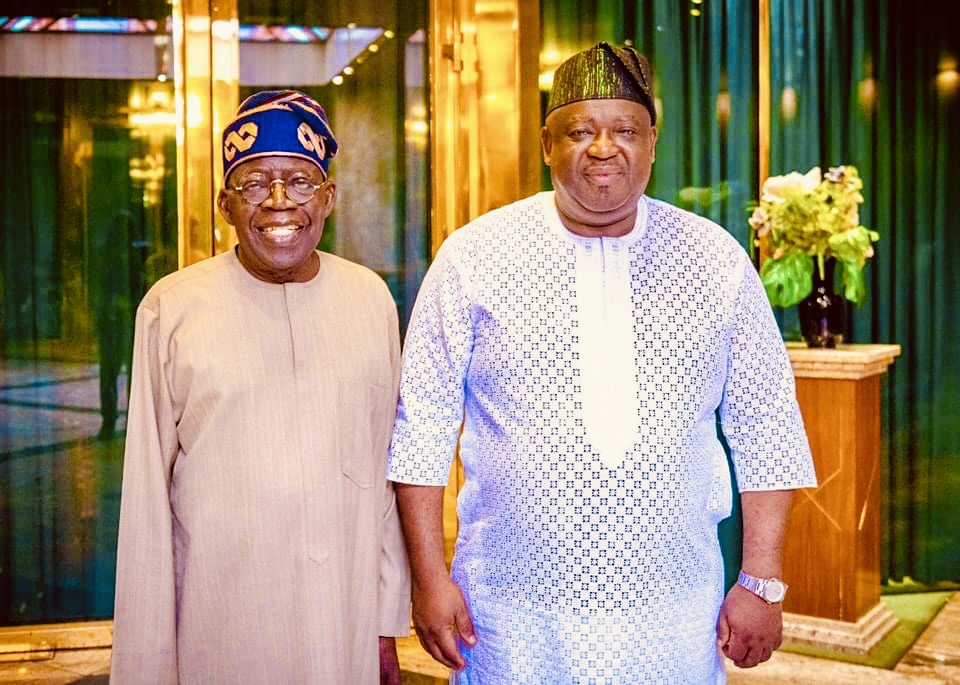
Photo:(R-L) Gov Mutfwang, President Tinubu.
Lalong bequeathed Plateau insolvent, I’d have filed for bankruptcy if… Mutfwang
In this interview with journalists in Jos, the Plateau State capital, Gov Caleb Mutfwang gives an insight into the enormity of the challenges which he inherited from his predecessor, former Gov Simon Lalong, especially a whooping total debt of over N300 billion, which has rendered the state insolvent, its protracted insecurity situation, unpaid demoralized and restless civil servants, who were on strike, and how the administration has been battling to bring the state back on track in the past 100 days in office.
Give us an idea of what you met on the ground when you took over three months ago…

Before we came into government, we had observed that Plateau State was in dire need of resuscitation. But, since we came on board, we have discovered that the situation is worse than we thought. Since we came on board three months ago, we discovered that there is no sector of life on the Plateau that does not need critical intervention.
During the electioneering campaign, we were under the impression that the state had a debt overhang of about N200 billion. But, to our greatest surprise, we discovered that it had gotten up to 300 billion. We found that the civil service, which is the engine room of the government, was practically on its knees. I say this not again just to blackmail people, but I can tell you we found a situation where even government documents were being typed in business centres, photocopied in business centres.
This is because things as simple as paper were not available in the offices. We met a salary burden of five months which accumulated to well over 11 billion and we met workers on strike. So, it was a very grim situation that confronted us when we took over. And as you know, even before we came in, a reign of terror was suddenly unleashed on the state, particularly in Mangu and Riyom local governments.
What we did upon coming on board was to tackle the issue of security headlong and one of the things we did immediately was to put out the true narrative for the world to know that there was no Plateau community fighting another community. It was an insurgency and a reign of terrorism and we thought that it was necessary to put that in perspective so that the security agencies would be up and doing to get to the root of the problem.
Hitherto the narrative has been farmers and herders clashing. But, I stand here as Governor of the state to tell you and to tell the world that that is not the narrative, that is not the reality on the ground. And I believe that every Plateau citizen is a logo of peace and that what has confronted us is terrorism that has come from outside. We say this because not only did the security agencies get the correct narrative that we must have the right mindset to be able to rise together to confront the challenges that the insurgency presents before us.
On my part, I took the liberty of visiting Mr. President, and I had very useful interactions with him. Telling him the true situation of the plateau, it was therefore not surprising that when I met with the security chiefs that have been newly appointed, they made it clear that Mr President had given them the matching orders that the situation on the plateau must be brought under control.
I want to thank Mr. President and the security chiefs because they immediately swung into action and I want to salute particularly the new GOC and commander of the STF, who came and demonstrated professionalism and didn’t stay in the air-conditioned office of his office in Rukuba he moved straight to Mangu where he stayed for close to a week where he was commanding the troops from the fraud. Indeed, it is not yet over, but I want to give glory to God that at the moment we can say we are experiencing relative peace.
Why did you recently call a meeting of the Elders’ Council, three months into your administration?
No land progresses and stays well without its elders. I believe that wisdom goes with age, and I was honoured that they turned up for the meeting. These are repositories of knowledge, repositories of wisdom and critical stakeholders of the Plateau Project. Several of them have paid their dues, having been in the struggle for the creation of this state and having served the state in different capacities at different times.
They have contributed immensely to the evolution of this state, and I want to thank God for keeping them alive at a time like this. It is a blessing that we have such quality human resources in Plateau. I will be a foolish governor not to bring them close and tap into their wisdom. When we took over May 29, we never came with a mindset that we knew it all. We knew in advance that there were several aspects of governance that we would learn on the job.
How are you tackling the prevailing security challenges?
As part of our efforts to ensure that the security situation is turned around and that peace is sustained, we have taken steps to revitalize Operation Rainbow in the next two to three weeks. It’s not going to be any hidden thing because Operational Rainbow is duly licensed by the federal government and therefore we’re going to make it fully operational and ensure that they perform their duty of protecting the respective communities. We are working in concert with the security agencies for the training of Operation Rainbow Manpower and I’m confident that they will go about their duties with a sense of patriotism. Also, we understood the danger of living in some of the abandoned lands. This is because if they were not taken possession of, they would soon become a bone of contention.
After due consultation, we mobilized the tractors in the ASTC and I think they cost close to 30 tractors and cultivated close to 900 hectares of life. Even though it’s late for the traditional crops that our farmers would have planted, there are still a few crops they can take advantage of to be able to farm on those lands that were duly cultivated by the government.
We are therefore hopeful that with these measures together we’ll be able to stem this type of insecurity. I’m glad that since we came on board we have held consistent security council meetings and I’ve also had the privilege of interacting with our first-class traditional rulers. It is in pursuit of the need for peace that we saw the need to call the meeting of the Plateau Elders Council and we hope that such a meeting will become periodic and consistent in the interest of peace and security of the state.
We also took steps to revive the Interreligious Council. We are looking at the appropriate timing for us to be able to hold that meeting. We will also be calling the Plateau Youth Council for interaction so that the issue of security is everybody’s business and therefore we must come together. What I found on coming on board is that there is so much intra-community conflict in virtually all our ethnic nationalities and as long as the intra-community conflicts remain, we cannot be able to achieve inter-community unity.
I, therefore want to appeal to every one of you to use your good offices as an elder in your community, to be able to foster unity amongst your people and also be able to promote unity beyond your people. For the rest of the people of Plateau, I’ve realised, and I do not need to think we need a prophet to tell us that, if we must develop and move forward, we must unite as a people. We cannot remain our own brothers’ enemies. We must become our brothers’ keepers, and I pray that God will infuse this spirit enough to know that divided we fall by united we stand.
How were you able to get the civil servants back to work?
It was not easy, but the workers are back to work. In our interaction with the workers, they insisted that we must be able to pay at least the salaries of February and March before they got back. This we did. So far, we have tried to offset the outstanding arrears of salary. We will stabilize the salary situation soon. This, of course, includes payment of pension arrears.
Besides the salary payment, what has been your intervention in other key sectors of the state?
We just returned from a retreat where we took all the appointees for a retreat at the National Institute of Policy and Strategic Studies. When we did the solvency analysis of Plateau State, we found that we are number 36 in the country! If Plateau was a business, it would have filed for bankruptcy. But it’s not a business; it’s about the lives and destinies of our people.