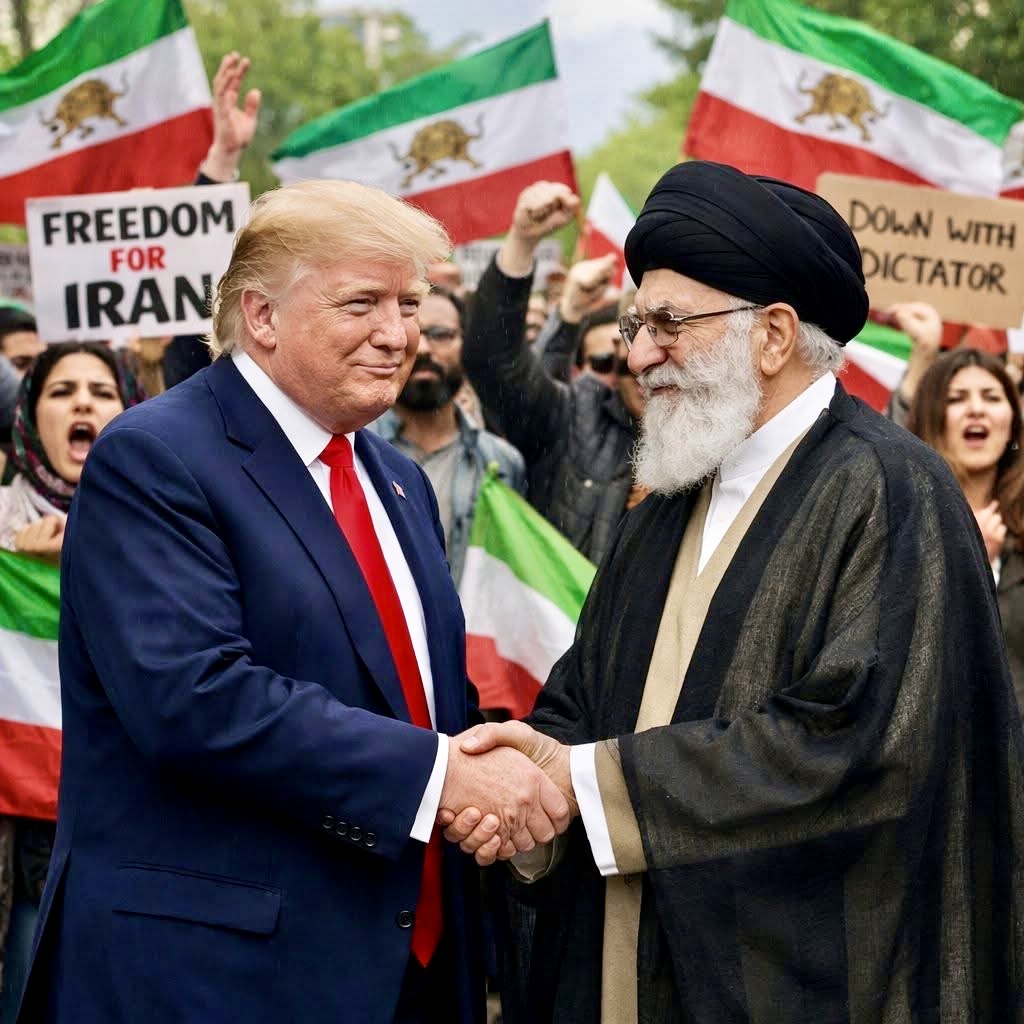
L-R: Trump, Ayatollah
For weeks, the noise suggested war. Threats. Warnings.
“All options on the table,” and then, Nothing! Absolutely Nothing. No strike. No assassination. No shock-and-awe moment.
Donald Trump stepped back from attacking Iran not because of sudden benevolence, and not because of a lack of firepower, but because reality intervened.

Iran made the cost of war unacceptably high.
Iran is not Iraq or Libya. And it certainly wasn’t a defenseless state waiting to be “liberated.”
Iran has spent decades doing one thing very well — Raising the price of aggression.
A direct U.S. attack would not have been a clean, one night operation, but would have triggered, retaliation across the region, threats to U.S. bases and allies, disruption of global energy routes.
A spiral no one, not Washington, not Tel Aviv, could fully control.
That deterrence worked. Not because Iran is “invincible,” but because war with Iran guarantees consequences, not headlines.
Regional allies quietly said: “Not From Here”.
Publicly, Gulf leaders urged calm. Privately, the message was firmer: Do not turn our countries into launchpads for a regional war.
The Middle East has changed. States that once enabled U.S. military adventures are now far more cautious, driven by economic stability, internal security, and regional diplomacy.
A war with Iran would not stay contained, and everyone in the region knows it.
When escalation lacks regional buy-in, even a superpower pauses.
Today, the same would probably happen, if the US tried an attack in Asia or Even Europe.
The US has clearly isolated itself, and has lost trust amongst long term allies.
Even for Trump, the escalation of risk outweighed Trump’s Political Theater by far.
Trump thrives on optics, but he also understands one thing: wars that drag on destroy presidencies.
A limited strike risks retaliation. Retaliation risks expansion.
Expansion risks a conflict, Trump could not neatly end, or sell to an American public weary of endless wars, and most of what he has so far brought to the once prestigious office.
This wasn’t about the kind of weakness we all recognise, but rather about, Trump’s inability to manage the risks associated with such unwarranted aggression.
Iran didn’t need to fire a shot to make that calculation unavoidable.
Diplomacy didn’t replace force; it beat it.
Behind the scenes, indirect communication channels worked precisely because both sides understood the stakes.
Iran made its position clear: escalation would be met, not absorbed. The U.S., despite its rhetoric, listened.
Whether this can be said to be capitulation is a debate for another day. But strategists look at this as deterrence functioning as designed.
Something Aftrican countries, especially Nigeria need to start looking at when deciding who to partner with.
The “Intelligence Shift” was a face-saving exit.
When leaders de-escalate after weeks of threats, they rarely say: “We reconsidered”.
Rather, they say: “New intelligence.” This intelligence wasn’t new, but rather, how great powers back away hoping not to lose face.
Unfortunately in this case, both the US and Israel have lost face, and it is alledged that all their spies have either been killed or captured.
At the end of the day, the truth is simple —The strategic environment didn’t favor war.
The Bigger Picture is not that Iran won because the U.S. is weak. Iran won because it made aggression irrational.
No invasion. No regime collapse. No assassination.
Just simple restraint, forced by realities on the ground, in the region, and in global politics.
In a world where power is often measured by how loudly one threatens war, Iran demonstrated something more enduring — The power to make war unnecessary.
And that, more than missiles or speeches, is why Trump didn’t attack, and why the US fell flat on its rhetoric.
Exactly the same tactic deployed by little Rocket man of North Korea.