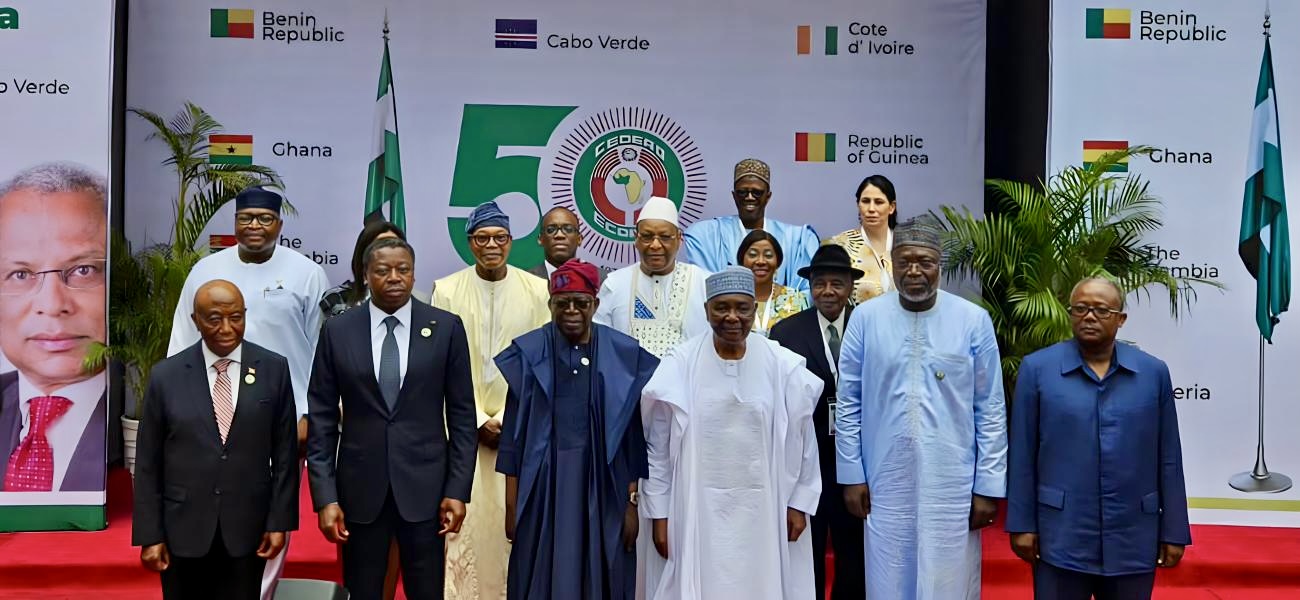
ECOWAS leaders and others during its Golden Jubilee in Lagos on May 28, 2025.
By Mark Longyen, News Agency of Nigeria (NAN)
It was a milestone deserving of popping the champagne and rolling out the drums in celebration.
The Economic Community of West African States (ECOWAS), founded on May 28, 1975, clocked 50 in May, 2025.
Once hailed as a model sub-regional organisation and a beacon of African integration, its 50 years milestone coincided with its worse epoch of existential threat.

As it marked the 50th anniversary amid prevailing challenges and the existential threats, the regional bloc found itself at a historic crossroads.
The number of surviving member states had dropped from the original 16 that had formed it during the famous Lagos Treaty in 1975, to 12.
Mauritania had pulled out from the bloc in December 2000, leaving it with 15 member states.
Mali, Burkina Faso, and Niger (the Sahel States) officially followed suit in January 2025, further reducing its membership to 12.
This elicited fears of more to follow and perhaps, its eventual disintegration.
The anniversary was a defining moment for ECOWAS, which had been navigating deep internal turbulence, while pursuing regional integration for the past five decades.
The year started on both a sour note and a grim reality – with the three Sahel States officially quitting the bloc on Jan. 29, 2025, against all odds and expectations.
In spite of various entreaties by regional leaders and stakeholders for the three states to rescind their decision, the moves fell on deaf ears.
Even the plea by Gen. Yakubu Gowon, the only surviving ECOWAS founding Head of State, to the young military leaders to reconsider their decision was not heeded.
The Authority of ECOWAS Heads of State and Government also despatched Togolese President and his Senegalese counterpart on shuttle diplomacy overtures to persuade them, without success.
About 12 months to their formal exit, they had statutorily notified ECOWAS of their intention to pull out.
The departing states later formed a parallel bloc – the Alliance of Sahel States (AES) – in 2024, and severed ties with ECOWAS.
This was a fallout of the sanctions and internal disagreements between them and ECOWAS leaders over the military coups in their countries amid security concerns.
By December 2025, months after its 50th anniversary milestone, ECOWAS was indeed facing a state of emergency due to severe security threats and political instability in the sub-region.
The security situation was sequel to escalating terrorist attacks, banditry, and military coups, which demanded immediate and intensified regional security responses.
The Sahel States’ departure culminated in regional instability as it created an opportunity for marauding terrorists to terrorise the sub-region’s large ungoverned spaces.
Analysts say that this development also contributed to a dip in the region’s economic growth forecast from 5.1 per cent to 5.0 per cent in 2025.
In spite of the Sahel States’ exit, ECOWAS kept its doors open for them, and is still actively re-engaging them, especially on joint security issues.
Amb. Abdel-Fatau Musah, ECOWAS Commissioner for Political Affairs, Peace and Security, says the aim is to “maintain dialogue and minimise the negative impacts of the split.”
The Sahel impasse was, however, just one in a myriad of challenges faced by ECOWAS in 2025.
The sub-region was also hit by a series of governance instability situations, which significantly challenged democratic governance across West Africa.
The political space in some member states, such as Togo and Côte d’Ivoire, shrank, raising concerns that warranted the intervention of regional stakeholders and leaders.
ECOWAS also encountered democratic backsliding late in 2025 following the military takeover of power in Guinea-Bissau, and an attempted coup in the Republic of Benin.
Dr Omar Touray, President of the ECOWAS Commission, in a speech at the Golden Jubilee celebration, said ECOWAS was worth celebrating, considering its 50 years of achievements amid formidable challenges.
He said that the anniversary was a moment for reflection, resilience, and recommitment to the vision of ECOWAS’ founding fathers, and urged its current leaders to ensure that the bloc remained intact and indivisible.
The commission’s president stressed that ECOWAS’s 50 years existence was a milestone, and called for a sobering assessment of the “crisis of democracy and security” facing West Africa.
“We are living through a moment of intense global disruption.
“This is not a time to retreat. This is a time to rise, just as we have done before,” he said.
Nigeria’s President Bola Tinubu, the then ECOWAS Chairman, decried the political turbulence in the region, and urged member states to remain united and avoid divisions that could “erode 50 years of progress.”
He highlighted the achievements of ECOWAS, and listed what he considered to be the bloc’s greatest “milestones” over the last five decades.
These, he said, included the ECOWAS Free Movement Protocol, the Trade Liberalisation Scheme, Peacekeeping Operations, and Healthcare provision.
One of ECOWAS’ milestone achievements in 2025 was in the area of infrastructure.
ECOWAS approved a dedicated Project Company and the expansion of international financial backing for its ambitious 25 billion dollars West African Gas Pipeline Extension Project (WAGPEP) and the Nigeria-Morocco Gas Pipeline Project (NMGP) merger.
The project, which was approved by ECOWAS in 2022, stretches nearly 6,000 km across West Africa.
It is designed to enhance regional energy access across the region and provide a secure link for Nigerian gas to reach Europe.
The project aims to extend the existing 678-km West African Gas Pipeline (running from Nigeria to Ghana) eventually reaching Morocco and Spain, passing through 13 countries to provide energy to over 400 million people.
Sédiko Douka, ECOWAS Commissioner for Infrastructure, Energy, and Digitalisation, describes the project as a pivotal step in ECOWAS’ energy and economic integration ambitions.
“This project is of vital importance for our region as it will create access to natural gas across West Africa, oil industries, agriculture, and power generation, and drive economic growth.
“The gas pipeline project supports both regional development and global climate goals by advancing clean energy initiatives, from mobility solutions to clean cooking options,” he said.
In December 2025, the Authority of ECOWAS Heads of State and Government at its 68th Ordinary Session held in Abuja declared a renewed focused on strengthening democracy and tackling terrorism through a reinvigorated, unified approach.
Julius Bio, Sierra Leone’s President and Chairman, ECOWAS Authority of Heads of State and Government, said the decision marked a defining moment for West Africa.
“West Africa faces some complex and evolving threats in its history, and instability in one nation is instability for all. No border can insulate us from violence or fragmentation.
“We must therefore strengthen collective action, integrated intelligence systems, coordinated border operations, and the operationalisation of ECOWAS as a standby force for counter-terrorism,” he said.
In 2025, ECOWAS also made continued efforts to promote trade, focusing on strengthening the ECOWAS Trade Liberalisation Scheme (ETLS), and the implementation of the African Continental Free Trade Area (AfCFTA).
West African leaders announced their declaration of a “united front” for economic diversification toward reducing the sub-region’s dependence on external trade.
ECOWAS also made some headway toward the actualisation of its single currency, the “Eco.” by making efforts to resolve the stumbling blocks in its the implementation.
Also, in 2025, ECOWAS leaders, in a landmark decision, adopted a policy to abolish all air transport taxes and slash passenger/security charges by 25 per cent across the sub-region to make air travel more affordable.
They said that West Africa was the most expensive region in the world for air travel, with taxes and charges accounting for up to 50 per cent, and in some cases, 70 per cent of the total ticket price.
ECOWAS noted that the high air fares were hindering the achievements of its Free Movement Protocol, the Trade Liberalisation Scheme, and also suffocating operating regional airlines.
The reforms, effective Jan. 1, 2026, are expected to engender positive economic impact, drop airfares by at least 40 per cent, and boost passenger traffic by about 30 per cent across the sub-region.
Analysts say that, in spite of the turbulence, 2025 was a year of critical reflection on ECOWAS’ strength, resilience, and power over the past 50 years, as well as reform efforts going forward.
ECOWAS must, however, step up its war against insecurity, violent extremism and terrorism with all that it takes, including the deployment modern technology.
It must, like never before, also ensure reforms that would restore institutional integrity, rebuild citizen trust to become the “ECOWAS of Peoples” of its dream.
There is, for instance, the urgent need to address its existential threat, which is posed by violent extremism and terrorism, incessant unconstitutional changes of government and the spate of member states’ exit.
Going forward, ECOWAS must come to terms with the fact that it is currently at a critical turning point, and must confront the reality of its chequered history and fractured union, headlong.(NANFeatures)(www.nannews.ng)