By Mark Longyen, Foreign Affairs Editor, News Agency of Nigeria (NAN)
In recent months, growing unease has gripped the international community as global leaders, analysts and diplomats warn that the world may be edging toward one of its most dangerous moments since the end of the Second World War.
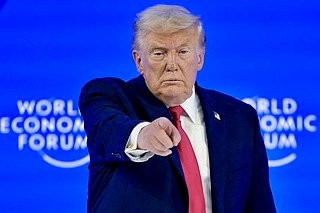
This anxiety was laid bare at the 2026 World Economic Forum in Davos, Switzerland, where Canada’s Prime Minister, Mark Carney, delivered a blunt assessment of the evolving global order.
Speaking without equivocation, Carney warned that the foreign policy posture of U.S. President Donald Trump now posed a direct threat to global peace, international security and the post-war rules-based system.

According to Carney, the recent U.S. invasion of Venezuela, threats to annex Greenland and the aggressive deployment of trade tariffs all point to a troubling return to a doctrine of coercion.
“Let me be direct. We are in the midst of a rupture, not a transition.
“The global rules-based order is collapsing, or may already have collapsed, under the weight of unilateral actions,” Carney said.
In a similar vein, French President Emmanuel Macron warned that the world was drifting toward lawlessness, where brute force increasingly overrides diplomacy.
“We are witnessing a shift toward a world without rules, where international law is trampled underfoot.
“The only law that seems to matter now is that of the strongest, with imperial ambitions resurfacing,” Macron said.
Trump himself appeared to signal this posture during his second-term inauguration on Jan. 20, 2025, when he declared to thunderous applause: “Nothing will stand in our way”.
Since then, analysts have described his foreign policy as defined by brinkmanship and mercantilism.
Many now characterise it as gunboat diplomacy, marked by the threat or use of military and economic force to secure strategic and territorial advantage.
As a result, America’s traditional allies, especially in Europe, are reassessing their dependence on Washington.
Former Deputy Commander of NATO in Europe, Richard Shirreff, warned that the U.S. is no longer behaving like a reliable partner.
“Under Trump, the United States has shifted from a valued ally to an avaricious imperial predator,” Shirreff said.
“This weakens NATO and creates dangerous opportunities for Russia”.
Shirreff added that European states are now being forced to confront uncomfortable questions about security guarantees that once seemed unquestionable.
Meanwhile, critics point to a series of unilateral actions, including the bombing of Iranian nuclear facilities, the capture and extradition of Venezuela’s former President, Nicolas Maduro, and the standoff with Denmark over Greenland, as developments capable of triggering wider conflicts.
Prof. Greg Grandin of Yale University says Trump’s actions mark a decisive break from liberal internationalism.
“What we are seeing is the renunciation of liberal internationalism and the abandonment of a world governed by common laws,” Grandin said.
He warned that Latin America is now precariously positioned between ideological forces.
“Trump’s dated strategy is putting us on a path to World War III,” he added.
This concern is shared within the U.S. political establishment.
Former Republican Senator and Chairman of the Senate Foreign Relations Committee, Bob Corker, said many lawmakers privately fear the consequences of Trump’s volatility.
“The vast majority of our caucus understands what we’re dealing with here.
“They understand the volatility and the tremendous amount of work it takes by people around him just to keep him in the middle of the road, “Corker said.
In Europe, tensions have further intensified over Trump’s pressure on Ukraine to accept a territorial settlement with Russia, alongside threats to withdraw U.S. security guarantees from NATO.
Trump reportedly warned Ukrainian President Volodymyr Zelensky that failure to resolve the conflict on U.S. terms could result in a loss of American support, a move analysts say resembles a stick-and-carrot strategy rather than diplomacy.
Earlier, Trump had insisted that the U.S. would accept nothing less than full ownership of Greenland, arguing that it was critical to U.S. security.
“This enormous, unsecured island is actually part of North America, That’s our territory, and we need it for our missile defence,” Trump said.
Although he later softened his position at Davos, the remarks sparked global criticism.
Elsewhere, the Middle East remains the most volatile flashpoint.
Trump’s deployment of multiple aircraft carriers around Iran and his stark warning have raised fears of escalation.
“Iran will be completely wiped off the face of the earth if it threatens the United States,” Trump warned.
Iran, however, has responded in equally forceful terms.
“Our hands are on the trigger,” Tehran warned, pledging to respond with “all available means” to any attack.
Israel’s muted contemplation of its so-called Samson Option; a last-resort nuclear response has further heightened anxieties, while Russia, China and North Korea have openly declared solidarity with Iran.
Beyond military posturing, Trump’s withdrawal from international treaties and organisations has weakened global safeguards against nuclear proliferation.
Analyst Zi Enlai warned that such actions are eroding critical guardrails.
“By exiting international organisations and treaties, the U.S. has reduced the mechanisms that prevent nuclear proliferation,” Enlai said.
“This risks a dangerous nuclear domino effect, particularly in Asia”.
Nowhere is this risk clearer than in U.S.–China relations. Washington’s record-breaking 11.1 billion-dollar arms sale to Taiwan has drawn sharp rebukes from Beijing.
“This crosses a red line,” China warned, responding with large-scale military drills around the island.
Analysts caution that the inclusion of long-range offensive weapons raises the risk of miscalculation, potentially drawing the world’s two largest nuclear powers into direct confrontation.
In Africa, Trump’s foreign policy has been equally polarising. While military actions against terrorist groups in Nigeria and Somalia have been welcomed by some, critics say his broader Africa strategy lacks vision.
Nigeria’s former Minister of Foreign Affairs, Prof. Bolaji Akinyemi, was unsparing in his assessment.
“Trump’s African foreign policy is uninspiring, shocking and depressing.
“Instead of rallying the world for peace, he is audaciously threatening it with a bouquet of hostile policies,” Akinyemi said.
Analyst Dr Olugbade Omotajo warned of historical parallels.
“When Hitler started, no one gave him a chance until he became a full-fledged monster.
“The question is whether Trump will end this world, or this world will end Trump, ” Omotajo said.
Observers also accuse Trump of undermining the United Nations by sidelining multilateral processes, including through the creation of a U.S.-led Gaza Board of Peace.
As regional bodies such as ECOWAS and the African Union warn of growing instability, analysts say unilateralism risks deepening geopolitical fragmentation and pushing fragile states toward alternative power blocs.
In sum, as Trump presses ahead with an assertive foreign policy rarely witnessed in recent history, the world finds itself navigating an era of profound uncertainty.
Whether these mounting tensions culminate in a catastrophic global conflict or are eventually tempered by diplomacy remains unclear.
What is certain, observers say, is that the consequences of miscalculation have never been higher. (NANFeatures)