By Abdul Hassan
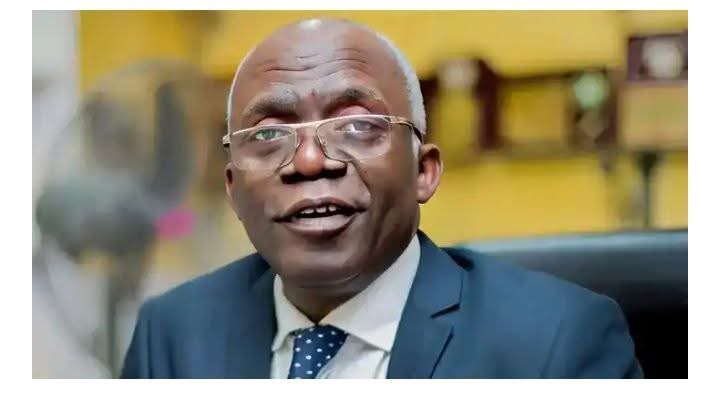
A renowned human rights lawyer and Senior Advocate of Nigeria (SAN) Femi Falana, has said that military officers accused of plotting a coup against the administration of President Bola Tinubu cannot be tried by court-martial under Nigeria’s democratic system.
According to him, such suspects must instead be prosecuted in civilian courts in line with constitutional provisions.

Falana made this clarification during an interview on Channels Television, where he addressed growing public debate over the appropriate legal framework for handling alleged coup attempts in a democratic setting.
He emphasized that Nigeria is no longer under military rule and that the constitution clearly outlines how crimes against an elected government should be prosecuted.
“We are under a democratic government, and as far as the constitution is concerned, we have to take them to a high court,” Falana said.
“The soldiers cannot be court-martialed, they are not trying to remove a military dictator.
“It’s an attempt to remove an elected government, a constitutional government, to disrupt the constitutional arrangement.”
The senior advocate explained that court-martial proceedings are designed primarily for breaches of military discipline and offenses committed strictly within the military hierarchy.
However, when the alleged offense amounts to treason or an attempt to overthrow a democratically elected government, the matter transcends internal military discipline and becomes a constitutional crime against the state.
Falana noted that prosecuting such cases through military tribunals would be inconsistent with democratic principles and could undermine the supremacy of the constitution.
He argued that treason and treasonable felony are offenses clearly defined under Nigerian law and fall squarely within the jurisdiction of civilian courts.
To support his position, Falana cited a historical precedent from Nigeria’s Second Republic.
He recalled the case of a Maiduguri-based businessman, Bukar Mandara, who was accused of plotting to mobilize soldiers to overthrow the civilian government of President Shehu Shagari in the early 1980s.
According to Falana, despite the involvement of military personnel in the alleged plot, the case was not handled by a military tribunal.
Instead, he said, Mandara was charged and prosecuted at the Federal High Court.
The trial, he noted, resulted in a conviction and a 50-year prison sentence, reinforcing the principle that threats to democratic governments must be addressed within the civilian judicial system.
“This is not new in our constitutional history,” Falana explained.
“When there is an attempt to overthrow a civilian government, the suspects are charged before a regular court of law, not a court-martial.
“That is the precedent, and it remains the law.”
The human rights lawyer further warned against conflating military rule-era practices with democratic governance.
He stressed that Nigeria’s return to civilian rule imposes clear legal boundaries on how security-related offenses are handled, even when members of the armed forces are involved.