By agency reports
China’s ambitious development of Jiangdong New Area in Haikou, capital of Hainan Province, is attracting growing attention as the district emerges as a major investment and industrial hub.
The development, which involves an investment of about 28 billion dollars, illustrates China’s strategy of combining infrastructure development, industrial diversification and trade liberalisation to stimulate economic growth.
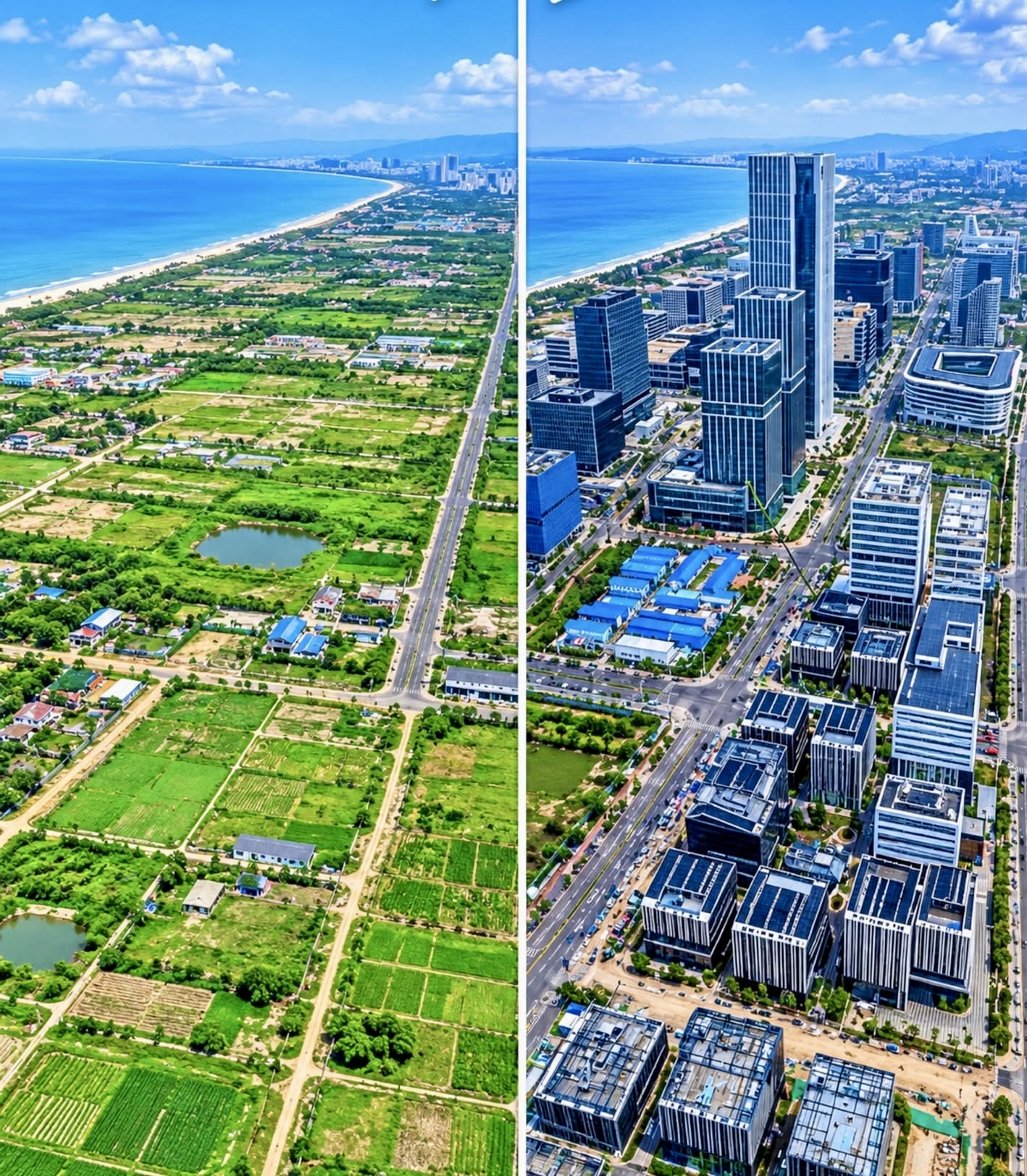
What was once largely undeveloped land has undergone a remarkable transformation, with modern office towers, corporate facilities, transport infrastructure and commercial establishments reshaping the landscape.

The district, officially known as Haikou Jiangdong New Area, covers approximately 298 square kilometres along the eastern coast of Haikou.
It is designed around two complementary zones: an eastern ecological area and a western area integrating industrial development with urban living.
The transformation reflects China’s broader ambition to establish Hainan as an international investment destination and a strategic gateway for economic engagement with global markets.
Jiangdong is increasingly positioning itself as a centre for corporate headquarters, modern services, international trade, aviation-related businesses and digital commerce.
Among the companies associated with the district’s expanding corporate presence are major Chinese energy groups, including PetroChina and Sinopec, both of which have significant interests in China’s economic development.
Beyond the traditional energy sector, the area is targeting emerging industries such as aircraft maintenance, cross-border e-commerce, modern logistics and other high-value services.
The strategy is to attract businesses that can benefit from Hainan’s evolving free trade policies, international connectivity and expanding commercial infrastructure.
A distinctive feature of Jiangdong’s development is its emphasis on integrating urban construction with environmental protection.
Rather than concentrating development entirely on concrete structures, its master plan incorporates wetlands, ecological corridors, green spaces and existing natural landscapes.
The approach seeks to demonstrate how modern urban expansion can coexist with environmental conservation, an increasingly important consideration for rapidly urbanising economies.
The development also comes at a significant moment in Hainan’s economic transformation.
On Dec. 18, 2025, the Hainan Free Trade Port formally commenced island-wide special customs operations, introducing a new framework for international trade and investment.
Under the arrangement, the island operates on the principle of liberalisation at the first line, effective control at the second line and freer movement within the island.
The policy also expanded the range of imported goods eligible for zero tariffs, with the proportion of tariff lines covered increasing from 21 per cent to 74 per cent, according to China’s National Development and Reform Commission.
The new arrangements are intended to reduce trade costs, improve customs efficiency and create a more favourable environment for businesses seeking access to international markets.
For Jiangdong, the free trade framework offers an opportunity to attract additional foreign capital, multinational companies and international service providers.
Its development also raises comparisons with Shanghai’s Pudong New Area, which evolved from a relatively underdeveloped area into one of China’s most prominent financial, commercial and technological centres.
Pudong’s experience demonstrates how infrastructure investment, policy reforms, international capital and sustained industrial development can reshape an urban economy over time.
However, Jiangdong’s long-term success will depend not simply on the construction of impressive buildings but on its ability to attract businesses, create employment, sustain investment and generate productive economic activities.
For African countries seeking to establish special economic zones, industrial parks and modern commercial districts, the project offers important areas for consideration.
These include the integration of infrastructure with industrial policy, the development of efficient trade systems, the attraction of international businesses and the protection of environmentally sensitive areas.
Ultimately, Jiangdong’s transformation represents another chapter in China’s experiment with urban development and economic opening-up.
Whether it eventually achieves the international economic prominence associated with Pudong will depend on how effectively it converts its physical infrastructure and policy advantages into sustainable commercial activities.